
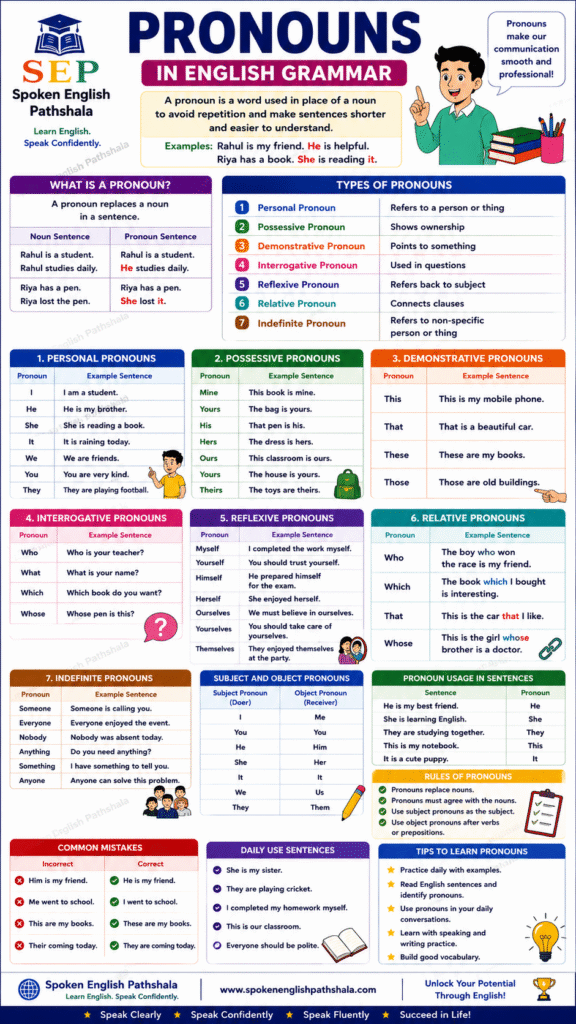
A pronoun is a word used in place of a noun to avoid repetition in sentences. Pronouns make sentences shorter, smoother, and easier to understand.
Examples:
- Rahul is my friend. He is very helpful.
- Riya has a book. She is reading it.
At Spoken English Pathshala, we provide simple English grammar lessons, spoken English practice, and easy grammar explanations for beginners and advanced learners.
What is a Pronoun?
A pronoun replaces a noun in a sentence.
Example:
| Noun Sentence | Pronoun Sentence |
|---|---|
| Rahul is a student. Rahul studies daily. | Rahul is a student. He studies daily. |
| Riya has a pen. Riya lost the pen. | Riya has a pen. She lost it. |
Types of Pronouns
| Type of Pronoun | Meaning |
|---|---|
| Personal Pronoun | Refers to a person or thing |
| Possessive Pronoun | Shows ownership |
| Demonstrative Pronoun | Points to something |
| Interrogative Pronoun | Used in questions |
| Reflexive Pronoun | Refers back to subject |
| Relative Pronoun | Connects clauses |
| Indefinite Pronoun | Refers to non-specific person or thing |
1. Personal Pronouns
Personal pronouns are used for persons, animals, or things.
Examples:
| Pronoun | Sentence |
|---|---|
| He | He is my friend. |
| She | She is reading a book. |
| It | It is raining today. |
| They | They are playing football. |
2. Possessive Pronouns
Possessive pronouns show ownership.
Examples:
| Pronoun | Sentence |
|---|---|
| Mine | This book is mine. |
| Yours | The bag is yours. |
| Ours | This classroom is ours. |
| Theirs | The house is theirs. |
3. Demonstrative Pronouns
Demonstrative pronouns point to specific things.
Examples:
| Pronoun | Sentence |
|---|---|
| This | This is my mobile phone. |
| That | That is a beautiful car. |
| These | These are my books. |
| Those | Those are old buildings. |
4. Interrogative Pronouns
Interrogative pronouns are used to ask questions.
Examples:
| Pronoun | Sentence |
|---|---|
| Who | Who is your teacher? |
| What | What is your name? |
| Which | Which book do you want? |
| Whose | Whose pen is this? |
5. Reflexive Pronouns
Reflexive pronouns refer back to the subject.
Examples:
| Pronoun | Sentence |
|---|---|
| Myself | I completed the work myself. |
| Yourself | You should trust yourself. |
| Himself | He prepared himself for the exam. |
| Themselves | They enjoyed themselves at the party. |
6. Relative Pronouns
Relative pronouns connect two parts of a sentence.
Examples:
| Pronoun | Sentence |
|---|---|
| Who | The boy who won the race is my friend. |
| Which | The book which I bought is interesting. |
| That | This is the car that I like. |
7. Indefinite Pronouns
Indefinite pronouns refer to unspecified people or things.
Examples:
| Pronoun | Sentence |
|---|---|
| Someone | Someone is calling you. |
| Everyone | Everyone enjoyed the event. |
| Nobody | Nobody was absent today. |
| Anything | Do you need anything? |
Subject and Object Pronouns
| Subject Pronoun | Object Pronoun |
|---|---|
| I | Me |
| He | Him |
| She | Her |
| We | Us |
| They | Them |
Pronoun Usage in Sentences
| Sentence | Pronoun |
|---|---|
| He is my best friend. | He |
| She is learning English. | She |
| They are studying together. | They |
| This is my notebook. | This |
Rules of Pronouns
| Rule | Example |
|---|---|
| Pronouns replace nouns | Rahul → He |
| Pronouns must agree with nouns | Riya → She |
| Use subject pronouns as subjects | He is playing. |
| Use object pronouns after verbs | I called him. |
Common Mistakes with Pronouns
| Incorrect | Correct |
|---|---|
| Him is my friend. | He is my friend. |
| Me went to school. | I went to school. |
| This are my books. | These are my books. |
| Their coming today. | They are coming today. |
Daily Use Sentences with Pronouns
| English Sentence | Hindi Meaning |
|---|---|
| She is my sister. | वह मेरी बहन है। |
| They are playing cricket. | वे क्रिकेट खेल रहे हैं। |
| I completed my homework myself. | मैंने अपना होमवर्क खुद पूरा किया। |
| This is our classroom. | यह हमारी कक्षा है। |
Tips to Learn Pronouns Easily
Practice Daily
Use pronouns in daily conversations.
Read English Sentences
Reading improves grammar understanding.
Learn with Examples
Practice simple pronoun sentences regularly.
Improve Vocabulary
Good vocabulary improves sentence formation.
Practice Speaking
Speaking practice improves grammar fluency.
Benefits of Learning Pronouns
- Improves grammar skills
- Makes sentences shorter and smoother
- Enhances spoken English
- Improves communication
- Helps in sentence formation
- Builds English fluency
Conclusion
Pronouns are very important in English grammar because they replace nouns and make communication easier and smoother. Learning pronouns helps learners improve grammar, spoken English, sentence structure, and communication skills.
Remember:
- Practice daily
- Learn different types of pronouns
- Read and speak regularly
- Use pronouns in conversations
- Improve vocabulary continuously
At Spoken English Pathshala, we provide simple English grammar lessons, spoken English practice, and communication skill development for learners of all levels.
FAQs About Pronouns
Q1. What is a pronoun?
A pronoun is a word used in place of a noun.
Q2. Why are pronouns important?
Pronouns make sentences smoother and avoid repetition.
Q3. What are the main types of pronouns?
Personal, possessive, demonstrative, interrogative, reflexive, relative, and indefinite pronouns.
Q4. What is the difference between subject and object pronouns?
Subject pronouns perform actions, while object pronouns receive actions.
Q5. How can I improve my understanding of pronouns?
Practice reading, writing, and speaking English daily.