
A verb is an action word or a state word used in a sentence. Verbs are one of the most important parts of English grammar because they show actions, conditions, or occurrences.
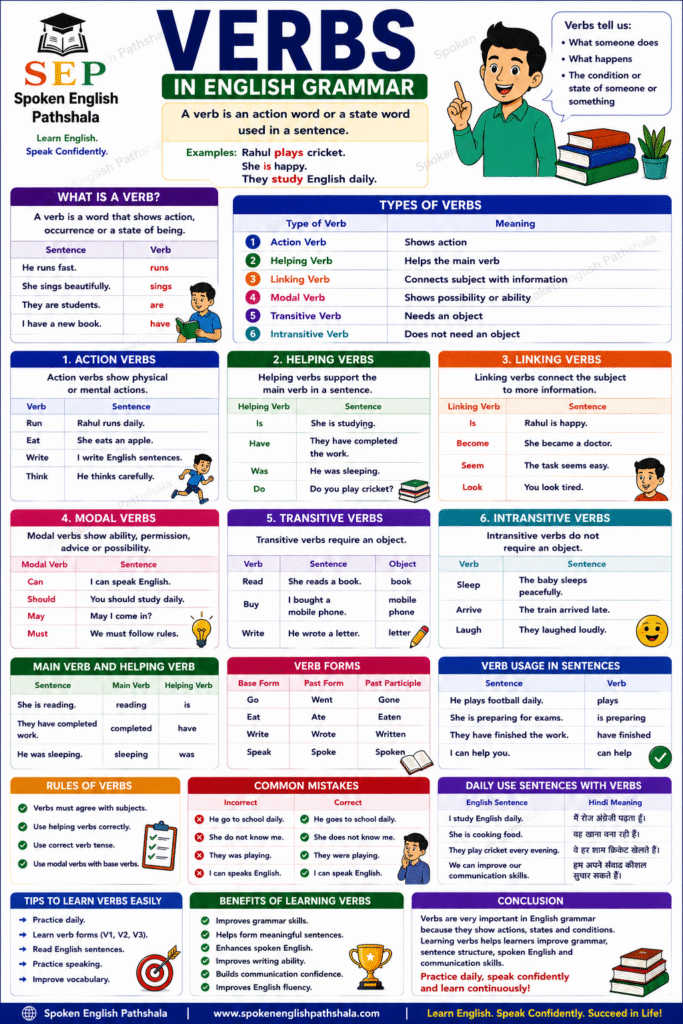
Examples:
- Rahul plays cricket.
- She is happy.
- They study English daily.
At Spoken English Pathshala, we provide simple English grammar lessons, spoken English practice, and easy grammar explanations for beginners and advanced learners.
What is a Verb?
A verb tells us:
- What someone does
- What happens
- The condition or state of someone or something
Examples:
| Sentence | Verb |
|---|---|
| He runs fast. | Runs |
| She sings beautifully. | Sings |
| They are students. | Are |
| I have a new book. | Have |
Types of Verbs
| Type of Verb | Meaning |
|---|---|
| Action Verb | Shows action |
| Helping Verb | Helps the main verb |
| Linking Verb | Connects subject with information |
| Modal Verb | Shows possibility or ability |
| Transitive Verb | Needs an object |
| Intransitive Verb | Does not need an object |
1. Action Verbs
Action verbs show physical or mental actions.
Examples:
| Verb | Sentence |
|---|---|
| Run | Rahul runs daily. |
| Eat | She eats an apple. |
| Write | I write English sentences. |
| Think | He thinks carefully. |
2. Helping Verbs
Helping verbs support the main verb in a sentence.
Examples:
| Helping Verb | Sentence |
|---|---|
| Is | She is studying. |
| Have | They have completed the work. |
| Was | He was sleeping. |
| Do | Do you play cricket? |
3. Linking Verbs
Linking verbs connect the subject to more information.
Examples:
| Linking Verb | Sentence |
|---|---|
| Is | Rahul is happy. |
| Become | She became a doctor. |
| Seem | The task seems easy. |
| Look | You look tired. |
4. Modal Verbs
Modal verbs show ability, permission, advice, or possibility.
Examples:
| Modal Verb | Sentence |
|---|---|
| Can | I can speak English. |
| Should | You should study daily. |
| May | May I come in? |
| Must | We must follow rules. |
5. Transitive Verbs
Transitive verbs require an object.
Examples:
| Verb | Sentence | Object |
|---|---|---|
| Read | She reads a book. | Book |
| Buy | I bought a mobile phone. | Mobile phone |
| Write | He wrote a letter. | Letter |
6. Intransitive Verbs
Intransitive verbs do not require an object.
Examples:
| Verb | Sentence |
|---|---|
| Sleep | The baby sleeps peacefully. |
| Arrive | The train arrived late. |
| Laugh | They laughed loudly. |
Main Verb and Helping Verb
| Sentence | Main Verb | Helping Verb |
|---|---|---|
| She is reading. | Reading | Is |
| They have completed work. | Completed | Have |
| He was sleeping. | Sleeping | Was |
Verb Forms
| Base Form | Past Form | Past Participle |
|---|---|---|
| Go | Went | Gone |
| Eat | Ate | Eaten |
| Write | Wrote | Written |
| Speak | Spoke | Spoken |
Verb Usage in Sentences
| Sentence | Verb |
|---|---|
| He plays football daily. | Plays |
| She is preparing for exams. | Is preparing |
| They have finished the work. | Have finished |
| I can help you. | Can help |
Rules of Verbs
| Rule | Example |
|---|---|
| Verbs must agree with subjects | He plays, They play |
| Use helping verbs correctly | She is studying |
| Use correct verb tense | I went yesterday |
| Use modal verbs with base verbs | Can speak, Should study |
Common Mistakes with Verbs
| Incorrect | Correct |
|---|---|
| He go to school daily. | He goes to school daily. |
| She do not know me. | She does not know me. |
| They was playing. | They were playing. |
| I can speaks English. | I can speak English. |
Daily Use Sentences with Verbs
| English Sentence | Hindi Meaning |
|---|---|
| I study English daily. | मैं रोज़ अंग्रेज़ी पढ़ता हूँ। |
| She is cooking food. | वह खाना बना रही है। |
| They play cricket every evening. | वे हर शाम क्रिकेट खेलते हैं। |
| We can improve our communication skills. | हम अपने संवाद कौशल सुधार सकते हैं। |
Tips to Learn Verbs Easily
Practice Daily
Use verbs while speaking and writing.
Learn Verb Forms
Memorize present, past, and past participle forms.
Read English Sentences
Reading improves grammar understanding.
Practice Speaking
Speaking improves fluency and confidence.
Improve Vocabulary
More vocabulary improves sentence formation.
Benefits of Learning Verbs
- Improves grammar skills
- Helps form meaningful sentences
- Enhances spoken English
- Improves writing ability
- Builds communication confidence
- Improves English fluency
Verbs are one of the most important parts of English grammar because they show actions, states, and conditions. Learning verbs helps learners improve grammar, sentence structure, spoken English, and communication skills.
Remember:
- Learn different types of verbs
- Practice daily
- Use verbs in conversations
- Improve vocabulary continuously
- Read and write regularly
At Spoken English Pathshala, we provide simple English grammar lessons, spoken English practice, and communication skill development for learners of all levels.
FAQs About Verbs
Q1. What is a verb?
A verb is an action or state word used in a sentence.
Q2. Why are verbs important?
Verbs help form complete and meaningful sentences.
Q3. What are the main types of verbs?
Action, helping, linking, modal, transitive, and intransitive verbs.
Q4. What is the difference between helping and main verbs?
Helping verbs support the main verb in a sentence.
Q5. How can I improve my understanding of verbs?
Practice reading, writing, and speaking English daily.