
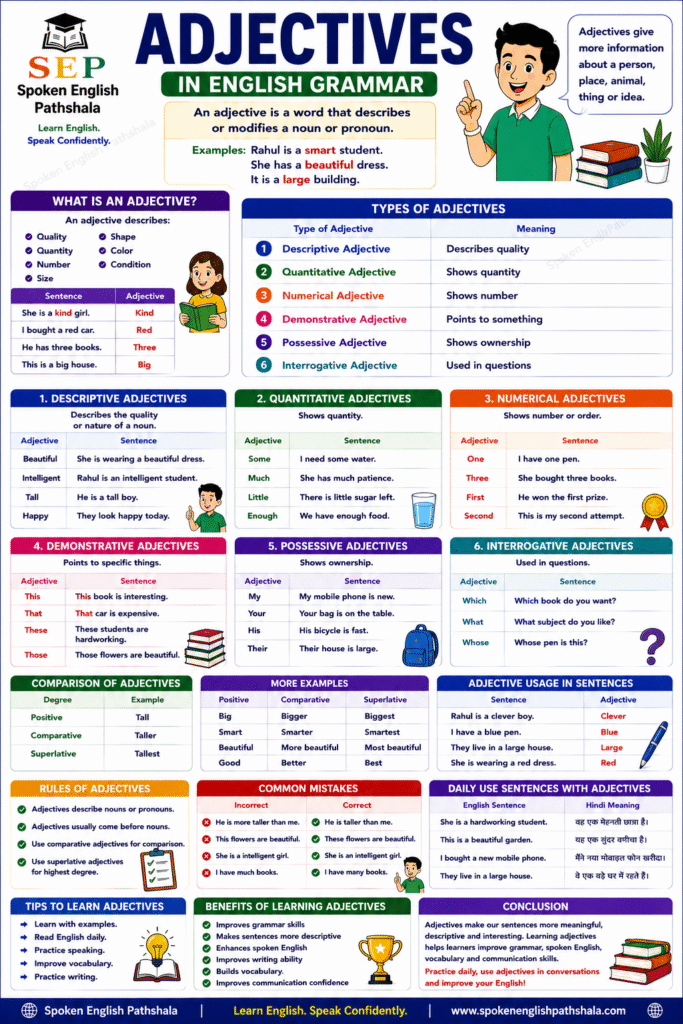
An adjective is a word that describes or modifies a noun or pronoun. Adjectives give more information about a person, place, animal, thing, or idea.
Examples:
- Rahul is a smart student.
- She has a beautiful dress.
- It is a large building.
At Spoken English Pathshala, we provide simple English grammar lessons, spoken English practice, and easy grammar explanations for beginners and advanced learners.
What is an Adjective?
An adjective describes:
- Quality
- Quantity
- Number
- Size
- Shape
- Color
- Condition
Examples:
| Sentence | Adjective |
|---|---|
| She is a kind girl. | Kind |
| I bought a red car. | Red |
| He has three books. | Three |
| This is a big house. | Big |
Types of Adjectives
| Type of Adjective | Meaning |
|---|---|
| Descriptive Adjective | Describes quality |
| Quantitative Adjective | Shows quantity |
| Numerical Adjective | Shows number |
| Demonstrative Adjective | Points to something |
| Possessive Adjective | Shows ownership |
| Interrogative Adjective | Used in questions |
1. Descriptive Adjectives
Descriptive adjectives describe the quality or nature of a noun.
Examples:
| Adjective | Sentence |
|---|---|
| Beautiful | She is wearing a beautiful dress. |
| Intelligent | Rahul is an intelligent student. |
| Tall | He is a tall boy. |
| Happy | They look happy today. |
2. Quantitative Adjectives
Quantitative adjectives show quantity.
Examples:
| Adjective | Sentence |
|---|---|
| Some | I need some water. |
| Much | She has much patience. |
| Little | There is little sugar left. |
| Enough | We have enough food. |
3. Numerical Adjectives
Numerical adjectives show number or order.
Examples:
| Adjective | Sentence |
|---|---|
| One | I have one pen. |
| Three | She bought three books. |
| First | He won the first prize. |
| Second | This is my second attempt. |
4. Demonstrative Adjectives
Demonstrative adjectives point to specific things.
Examples:
| Adjective | Sentence |
|---|---|
| This | This book is interesting. |
| That | That car is expensive. |
| These | These students are hardworking. |
| Those | Those flowers are beautiful. |
5. Possessive Adjectives
Possessive adjectives show ownership.
Examples:
| Adjective | Sentence |
|---|---|
| My | My mobile phone is new. |
| Your | Your bag is on the table. |
| His | His bicycle is fast. |
| Their | Their house is large. |
6. Interrogative Adjectives
Interrogative adjectives are used in questions.
Examples:
| Adjective | Sentence |
|---|---|
| Which | Which book do you want? |
| What | What subject do you like? |
| Whose | Whose pen is this? |
Comparison of Adjectives
| Degree | Example |
|---|---|
| Positive | Tall |
| Comparative | Taller |
| Superlative | Tallest |
More Examples:
| Positive | Comparative | Superlative |
|---|---|---|
| Big | Bigger | Biggest |
| Smart | Smarter | Smartest |
| Beautiful | More beautiful | Most beautiful |
Adjective Usage in Sentences
| Sentence | Adjective |
|---|---|
| Rahul is a clever boy. | Clever |
| I have a blue pen. | Blue |
| They live in a large house. | Large |
| She is wearing a red dress. | Red |
Rules of Adjectives
| Rule | Example |
|---|---|
| Adjectives describe nouns or pronouns | Beautiful girl |
| Adjectives usually come before nouns | Red car |
| Use comparative adjectives for comparison | Taller than Rahul |
| Use superlative adjectives for highest degree | The tallest student |
Common Mistakes with Adjectives
| Incorrect | Correct |
|---|---|
| He is more taller than me. | He is taller than me. |
| This flowers are beautiful. | These flowers are beautiful. |
| She is a intelligent girl. | She is an intelligent girl. |
| I have much books. | I have many books. |
Daily Use Sentences with Adjectives
| English Sentence | Hindi Meaning |
|---|---|
| She is a hardworking student. | वह एक मेहनती छात्रा है। |
| This is a beautiful garden. | यह एक सुंदर बगीचा है। |
| I bought a new mobile phone. | मैंने नया मोबाइल फोन खरीदा। |
| They live in a large house. | वे एक बड़े घर में रहते हैं। |
Tips to Learn Adjectives Easily
Learn with Examples
Practice adjectives using simple sentences.
Read English Daily
Reading improves grammar understanding.
Practice Speaking
Use adjectives in daily conversations.
Improve Vocabulary
More vocabulary improves communication skills.
Practice Writing
Write sentences using different adjectives.
Benefits of Learning Adjectives
- Improves grammar skills
- Makes sentences more descriptive
- Enhances spoken English
- Improves writing ability
- Builds vocabulary
- Improves communication confidence
Adjectives are very important in English grammar because they make sentences more meaningful, descriptive, and interesting. Learning adjectives helps learners improve grammar, spoken English, vocabulary, and communication skills.
Remember:
- Learn different types of adjectives
- Practice daily
- Use adjectives in conversations
- Improve vocabulary continuously
- Read and write regularly
At Spoken English Pathshala, we provide simple English grammar lessons, spoken English practice, and communication skill development for learners of all levels.
FAQs About Adjectives
Q1. What is an adjective?
An adjective is a word that describes a noun or pronoun.
Q2. Why are adjectives important?
Adjectives make sentences more descriptive and meaningful.
Q3. What are the main types of adjectives?
Descriptive, quantitative, numerical, demonstrative, possessive, and interrogative adjectives.
Q4. What are comparative and superlative adjectives?
They are used to compare people, places, or things.
Q5. How can I improve my understanding of adjectives?
Practice reading, writing, and speaking English daily.