
An adverb is a word that modifies or describes a verb, adjective, or another adverb. Adverbs provide more information about how, when, where, or to what extent something happens.
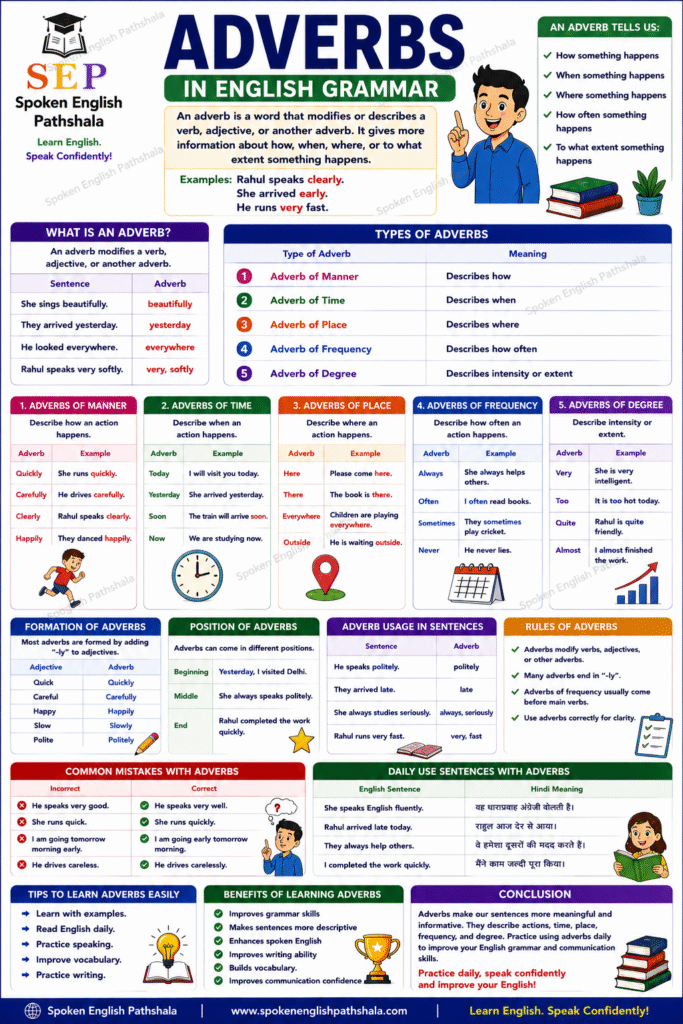
Examples:
- Rahul speaks clearly.
- She arrived early.
- He runs very fast.
At Spoken English Pathshala, we provide simple English grammar lessons, spoken English practice, and easy grammar explanations for beginners and advanced learners.
What is an Adverb?
An adverb tells us:
- How something happens
- When something happens
- Where something happens
- How often something happens
- To what extent something happens
Examples:
| Sentence | Adverb |
|---|---|
| She sings beautifully. | Beautifully |
| They arrived yesterday. | Yesterday |
| He looked everywhere. | Everywhere |
| Rahul speaks very softly. | Very, softly |
Types of Adverbs
| Type of Adverb | Meaning |
|---|---|
| Adverb of Manner | Describes how |
| Adverb of Time | Describes when |
| Adverb of Place | Describes where |
| Adverb of Frequency | Describes how often |
| Adverb of Degree | Describes intensity |
1. Adverbs of Manner
Adverbs of manner describe how an action happens.
Examples:
| Adverb | Sentence |
|---|---|
| Quickly | She runs quickly. |
| Carefully | He drives carefully. |
| Clearly | Rahul speaks clearly. |
| Happily | They danced happily. |
2. Adverbs of Time
Adverbs of time describe when an action happens.
Examples:
| Adverb | Sentence |
|---|---|
| Today | I will visit you today. |
| Yesterday | She arrived yesterday. |
| Soon | The train will arrive soon. |
| Now | We are studying now. |
3. Adverbs of Place
Adverbs of place describe where an action happens.
Examples:
| Adverb | Sentence |
|---|---|
| Here | Please come here. |
| There | The book is there. |
| Everywhere | Children are playing everywhere. |
| Outside | He is waiting outside. |
4. Adverbs of Frequency
Adverbs of frequency describe how often an action happens.
Examples:
| Adverb | Sentence |
|---|---|
| Always | She always helps others. |
| Often | I often read books. |
| Sometimes | They sometimes play cricket. |
| Never | He never lies. |
5. Adverbs of Degree
Adverbs of degree describe intensity or extent.
Examples:
| Adverb | Sentence |
|---|---|
| Very | She is very intelligent. |
| Too | It is too hot today. |
| Quite | Rahul is quite friendly. |
| Almost | I almost finished the work. |
Adverb Usage in Sentences
| Sentence | Adverb |
|---|---|
| He speaks politely. | Politely |
| They arrived late. | Late |
| She always studies seriously. | Always, seriously |
| Rahul runs very fast. | Very, fast |
Formation of Adverbs
Most adverbs are formed by adding -ly to adjectives.
| Adjective | Adverb |
|---|---|
| Quick | Quickly |
| Careful | Carefully |
| Happy | Happily |
| Slow | Slowly |
Position of Adverbs
| Position | Example |
|---|---|
| Beginning | Yesterday, I visited Delhi. |
| Middle | She always speaks politely. |
| End | Rahul completed the work quickly. |
Rules of Adverbs
| Rule | Example |
|---|---|
| Adverbs modify verbs, adjectives, or adverbs | She sings beautifully. |
| Many adverbs end in “-ly” | Slowly, carefully |
| Adverbs of frequency usually come before main verbs | He always studies. |
| Use adverbs correctly for clarity | Speak clearly. |
Common Mistakes with Adverbs
| Incorrect | Correct |
|---|---|
| He speaks very good. | He speaks very well. |
| She runs quick. | She runs quickly. |
| I am going tomorrow morning early. | I am going early tomorrow morning. |
| He drives careless. | He drives carelessly. |
Daily Use Sentences with Adverbs
| English Sentence | Hindi Meaning |
|---|---|
| She speaks English fluently. | वह धाराप्रवाह अंग्रेज़ी बोलती है। |
| Rahul arrived late today. | राहुल आज देर से आया। |
| They always help others. | वे हमेशा दूसरों की मदद करते हैं। |
| I completed the work quickly. | मैंने काम जल्दी पूरा किया। |
Tips to Learn Adverbs Easily
Learn with Examples
Practice adverbs using simple daily sentences.
Read English Daily
Reading improves grammar understanding.
Practice Speaking
Use adverbs while speaking English.
Improve Vocabulary
More vocabulary improves sentence formation.
Practice Writing
Write sentences using different adverbs.
Benefits of Learning Adverbs
- Improves grammar skills
- Makes sentences more descriptive
- Enhances spoken English
- Improves writing ability
- Builds vocabulary
- Improves communication confidence
Adverbs are very important in English grammar because they provide more information about actions, qualities, and conditions. Learning adverbs helps learners improve grammar, spoken English, sentence structure, and communication skills.
Remember:
- Learn different types of adverbs
- Practice daily
- Use adverbs in conversations
- Improve vocabulary continuously
- Read and write regularly
At Spoken English Pathshala, we provide simple English grammar lessons, spoken English practice, and communication skill development for learners of all levels.
FAQs About Adverbs
Q1. What is an adverb?
An adverb is a word that modifies a verb, adjective, or another adverb.
Q2. Why are adverbs important?
Adverbs make sentences more descriptive and meaningful.
Q3. What are the main types of adverbs?
Manner, time, place, frequency, and degree adverbs.
Q4. How are most adverbs formed?
Most adverbs are formed by adding “-ly” to adjectives.
Q5. How can I improve my understanding of adverbs?
Practice reading, writing, and speaking English daily.