
Active and Passive Voice are important topics in English grammar. They help learners improve sentence structure, spoken English, writing skills, communication confidence, and grammar accuracy.
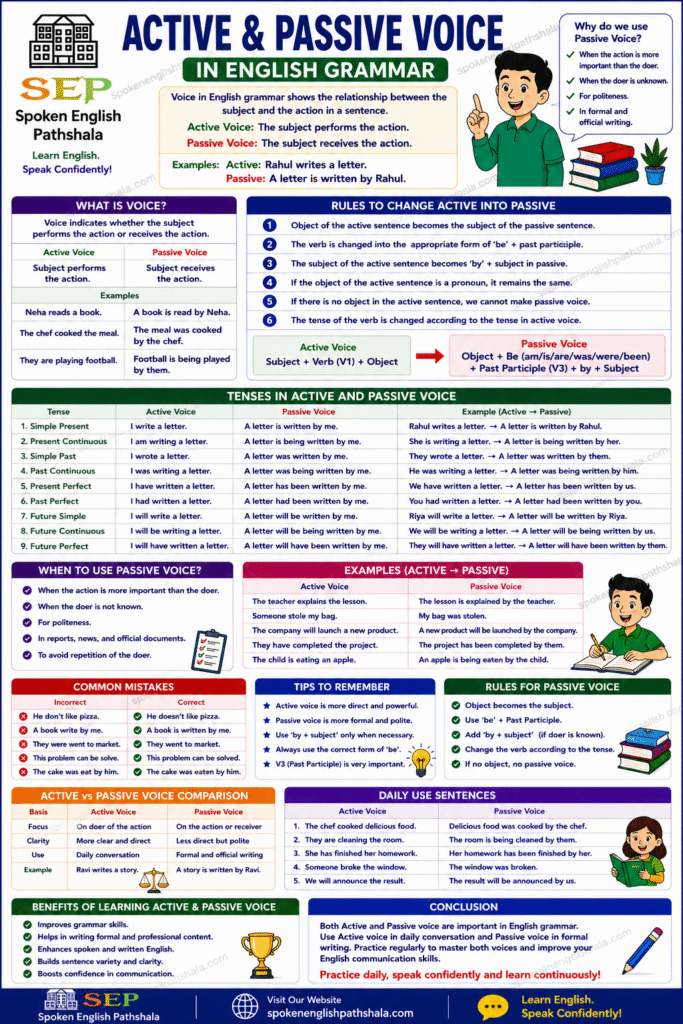
Understanding active and passive voice is useful for:
- Spoken English
- Competitive exams
- School grammar
- IELTS preparation
- SSC English
- Banking English
- Railway exam preparation
- Professional communication
At Spoken English Pathshala, we provide easy English grammar lessons, spoken English practice, vocabulary improvement, and communication training for learners of all levels.
What is Active Voice?
In Active Voice, the subject performs the action.
Active Voice Structure
Subject + Verb + Object
Examples of Active Voice
| Active Voice Sentence | Explanation |
|---|---|
| Rahul writes a letter. | Rahul performs the action. |
| She cooks food. | She does the action. |
| They completed the project. | They performed the action. |
| The teacher explains the lesson. | The teacher performs the action. |
What is Passive Voice?
In Passive Voice, the subject receives the action.
Passive Voice Structure
Object + Helping Verb + Past Participle (V3) + by + Subject
Examples of Passive Voice
| Passive Voice Sentence | Explanation |
|---|---|
| A letter is written by Rahul. | The subject receives the action. |
| Food is cooked by her. | Food receives the action. |
| The project was completed by them. | The project receives the action. |
| The lesson is explained by the teacher. | The lesson receives the action. |
Difference Between Active and Passive Voice
| Active Voice | Passive Voice |
|---|---|
| The subject performs the action. | The subject receives the action. |
| More direct and clear | More formal and indirect |
| Common in spoken English | Common in formal writing |
| Rahul writes a letter. | A letter is written by Rahul. |
Rules to Change Active Voice into Passive Voice
1. Object Becomes Subject
The object of the active sentence becomes the subject in passive voice.
Example:
- Active: Rahul writes a letter.
- Passive: A letter is written by Rahul.
2. Use Correct Helping Verb
Use helping verbs according to tense:
- is
- am
- are
- was
- were
- be
- been
- being
Example:
- The homework is completed.
- The room was cleaned.
3. Use Past Participle (V3)
The main verb changes into the third form.
| Verb | V2 | V3 |
|---|---|---|
| Write | Wrote | Written |
| Eat | Ate | Eaten |
| Complete | Completed | Completed |
| Speak | Spoke | Spoken |
4. Use “By” Before Subject
Use “by” before the doer when needed.
Example:
- The cake was baked by Riya.
Tenses in Active and Passive Voice
| Tense | Active Voice | Passive Voice |
|---|---|---|
| Simple Present | She writes a letter. | A letter is written by her. |
| Present Continuous | She is writing a letter. | A letter is being written by her. |
| Simple Past | She wrote a letter. | A letter was written by her. |
| Present Perfect | She has written a letter. | A letter has been written by her. |
| Future Simple | She will write a letter. | A letter will be written by her. |
When to Use Passive Voice?
Passive voice is commonly used:
- When the doer is unknown
- When the action is important
- In formal writing
- In news reports
- In official communication
- In scientific writing
Examples:
- The road was repaired yesterday.
- The results were announced today.
- English is spoken worldwide.
Active and Passive Voice Examples
| Active Voice | Passive Voice |
|---|---|
| The chef cooked delicious food. | Delicious food was cooked by the chef. |
| They are cleaning the room. | The room is being cleaned by them. |
| Someone stole my bag. | My bag was stolen. |
| We will announce the result. | The result will be announced by us. |
Common Mistakes in Active and Passive Voice
| Incorrect Sentence | Correct Sentence |
|---|---|
| A book write by me. | A book is written by me. |
| The work completed by Rahul. | The work was completed by Rahul. |
| Food cooked by mother. | Food was cooked by mother. |
| He don’t like pizza. | He doesn’t like pizza. |
Daily Use Sentences of Active and Passive Voice
| Active Voice | Passive Voice |
|---|---|
| The teacher teaches English. | English is taught by the teacher. |
| They built a new bridge. | A new bridge was built by them. |
| She completed her homework. | Her homework was completed by her. |
| We are organizing the event. | The event is being organized by us. |
Tips to Learn Active and Passive Voice Easily
Learn Verb Forms
Practice V1, V2, and V3 forms daily.
Understand Tenses
Tense knowledge improves sentence conversion.
Practice Sentence Conversion
Convert active sentences into passive daily.
Read English Grammar Examples
Reading improves grammar understanding.
Practice Speaking and Writing
Use active and passive voice regularly.
Benefits of Learning Active and Passive Voice
- Improves grammar skills
- Enhances spoken English
- Improves writing ability
- Helps in competitive exams
- Improves formal communication
- Builds communication confidence
Active and Passive Voice are very important parts of English grammar. Active voice is commonly used in spoken English, while passive voice is useful in formal writing and professional communication.
Regular practice helps learners improve:
- Grammar accuracy
- Spoken English
- Writing skills
- Communication confidence
Remember:
- Practice daily
- Learn verb forms
- Improve tense knowledge
- Read English regularly
- Use grammar in conversations
At Spoken English Pathshala, we provide easy English grammar lessons, spoken English training, and communication skill development for learners and competitive exam students.
FAQs About Active and Passive Voice
Q1. What is Active Voice in English grammar?
Active voice is when the subject performs the action.
Q2. What is Passive Voice?
Passive voice is when the subject receives the action.
Q3. Why is Passive Voice important?
Passive voice is important for formal writing and professional communication.
Q4. What is the structure of Passive Voice?
Object + Helping Verb + Past Participle + by + Subject.
Q5. How can I improve Active and Passive Voice?
Practice grammar exercises and sentence conversion regularly.