
Direct and Indirect Speech are important topics in English grammar. They help learners improve sentence structure, spoken English, writing skills, communication confidence, and grammar accuracy.
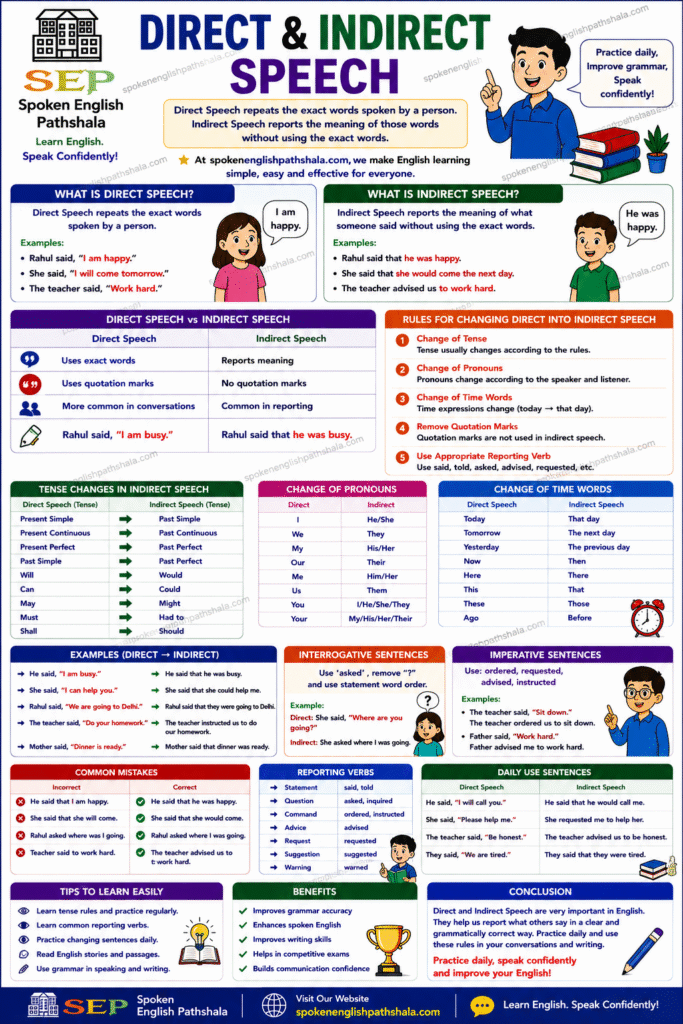
Direct and Indirect Speech are widely used in:
- Spoken English
- School grammar
- Competitive exams
- SSC English
- Banking English
- IELTS preparation
- Professional communication
- Daily conversations
At Spoken English Pathshala, we provide simple English grammar lessons, spoken English practice, vocabulary improvement, and communication training for learners of all levels.
What is Direct Speech?
Direct Speech repeats the exact words spoken by a person.
Structure of Direct Speech
Speaker + Reporting Verb + “Exact Words”
Examples of Direct Speech
| Direct Speech | Meaning |
|---|---|
| Rahul said, “I am happy.” | Exact words are repeated. |
| She said, “I will come tomorrow.” | Original sentence is unchanged. |
| The teacher said, “Work hard.” | Exact instruction is repeated. |
What is Indirect Speech?
Indirect Speech reports the meaning of what someone said without using the exact words.
Structure of Indirect Speech
Speaker + Reporting Verb + Reported Speech
Examples of Indirect Speech
| Indirect Speech | Meaning |
|---|---|
| Rahul said that he was happy. | Words are reported indirectly. |
| She said that she would come the next day. | Sentence structure changes. |
| The teacher advised us to work hard. | Meaning is reported. |
Difference Between Direct and Indirect Speech
| Direct Speech | Indirect Speech |
|---|---|
| Uses exact words | Reports meaning |
| Uses quotation marks | No quotation marks |
| More common in conversations | Common in reporting |
| Rahul said, “I am busy.” | Rahul said that he was busy. |
Rules for Changing Direct into Indirect Speech
1. Change of Tense
When the reporting verb is in the past tense, the tense usually changes.
| Direct Speech | Indirect Speech |
|---|---|
| Present Simple | Past Simple |
| Present Continuous | Past Continuous |
| Present Perfect | Past Perfect |
| Will | Would |
Examples:
- He said, “I play cricket.”
- He said that he played cricket.
2. Change of Pronouns
Pronouns change according to the speaker and listener.
| Direct | Indirect |
|---|---|
| I | He/She |
| We | They |
| My | His/Her |
| Our | Their |
Example:
- She said, “I love my family.”
- She said that she loved her family.
3. Change of Time Words
| Direct Speech | Indirect Speech |
|---|---|
| Today | That day |
| Tomorrow | The next day |
| Yesterday | The previous day |
| Now | Then |
| Here | There |
Example:
- Rahul said, “I will come tomorrow.”
- Rahul said that he would come the next day.
4. Remove Quotation Marks
Quotation marks are removed in indirect speech.
Example:
- Direct: She said, “I am tired.”
- Indirect: She said that she was tired.
Reporting Verbs in Direct and Indirect Speech
| Sentence Type | Reporting Verb |
|---|---|
| Statement | Said, told |
| Question | Asked, inquired |
| Command | Ordered, requested |
| Advice | Advised |
| Request | Requested |
Direct and Indirect Speech Examples
| Direct Speech | Indirect Speech |
|---|---|
| He said, “I am busy.” | He said that he was busy. |
| She said, “I can help you.” | She said that she could help me. |
| Rahul said, “We are going to Delhi.” | Rahul said that they were going to Delhi. |
| The teacher said, “Complete your homework.” | The teacher instructed us to complete our homework. |
Interrogative Sentences in Indirect Speech
Rules:
- Use “asked”
- Remove question mark
- Use statement word order
Example:
- Direct: She said, “Where are you going?”
- Indirect: She asked where I was going.
Imperative Sentences in Indirect Speech
Rules:
Use:
- ordered
- requested
- advised
- instructed
Examples:
| Direct Speech | Indirect Speech |
|---|---|
| The teacher said, “Sit down.” | The teacher ordered us to sit down. |
| Father said, “Work hard.” | Father advised me to work hard. |
Common Mistakes in Direct and Indirect Speech
| Incorrect Sentence | Correct Sentence |
|---|---|
| He said that I am happy. | He said that he was happy. |
| She said that she will come. | She said that she would come. |
| Rahul asked where was I going. | Rahul asked where I was going. |
| Teacher said to work hard. | The teacher advised us to work hard. |
Daily Use Sentences
| Direct Speech | Indirect Speech |
|---|---|
| Mother said, “Dinner is ready.” | Mother said that dinner was ready. |
| He said, “I will call you.” | He said that he would call me. |
| She said, “Please help me.” | She requested me to help her. |
| The teacher said, “Do your homework.” | The teacher instructed us to do our homework. |
Tips to Learn Direct and Indirect Speech Easily
Learn Tense Rules
Tense understanding improves sentence conversion.
Practice Daily
Practice changing direct speech into indirect speech.
Learn Reporting Verbs
Use correct reporting verbs for statements and questions.
Read English Examples
Reading improves grammar understanding.
Practice Speaking and Writing
Use reported speech in conversations and writing.
Benefits of Learning Direct and Indirect Speech
- Improves grammar skills
- Enhances spoken English
- Improves writing ability
- Helps in competitive exams
- Improves communication confidence
- Builds professional communication skills
Direct and Indirect Speech are important parts of English grammar. They help learners improve sentence structure, communication skills, spoken English, and writing ability.
Regular practice improves:
- Grammar accuracy
- Spoken English
- Writing confidence
- Communication skills
Remember:
- Learn tense changes
- Practice daily
- Improve vocabulary
- Read English regularly
- Use grammar in conversations
At Spoken English Pathshala, we provide easy English grammar lessons, spoken English training, and communication skill development for learners and competitive exam students.
FAQs About Direct and Indirect Speech
Q1. What is Direct Speech?
Direct speech repeats the exact words spoken by a person.
Q2. What is Indirect Speech?
Indirect speech reports the meaning of what someone said.
Q3. Why do tenses change in indirect speech?
Tenses usually change when the reporting verb is in the past tense.
Q4. What are reporting verbs?
Reporting verbs are words like said, told, asked, advised, and requested.
Q5. How can I improve Direct and Indirect Speech?
Practice grammar exercises and sentence conversion daily.