
Synonyms and Antonyms in English Grammar
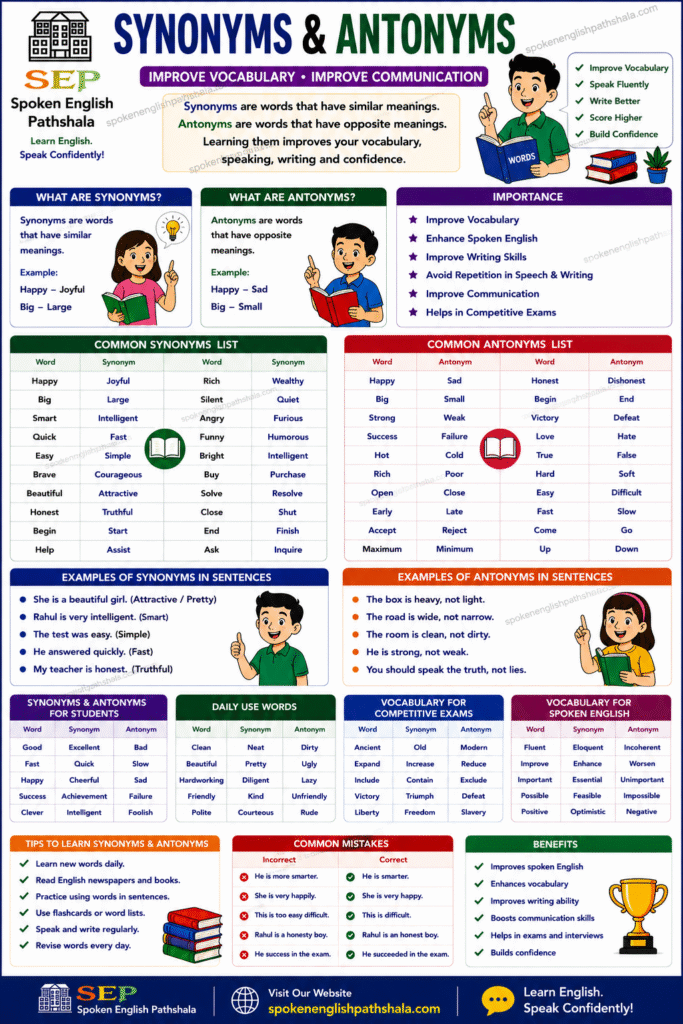
Synonyms and Antonyms are important parts of English vocabulary and grammar. Learning them helps improve:
- Spoken English
- Vocabulary knowledge
- Communication skills
- Writing ability
- Reading comprehension
- Competitive exam preparation
Synonyms and antonyms are commonly used in:
- SSC English
- Banking English
- Railway exams
- IELTS preparation
- School grammar
- Spoken English practice
- Daily communication
At Spoken English Pathshala, we provide simple English grammar lessons, vocabulary improvement, spoken English practice, and communication skill development for learners of all levels.
What are Synonyms?
Synonyms are words that have similar meanings.
Examples of Synonyms
| Word | Synonym |
|---|---|
| Happy | Joyful |
| Big | Large |
| Smart | Intelligent |
| Quick | Fast |
| Easy | Simple |
Example Sentences:
- Rahul is a smart student.
- Rahul is an intelligent student.
Both sentences have similar meanings.
What are Antonyms?
Antonyms are words that have opposite meanings.
Examples of Antonyms
| Word | Antonym |
|---|---|
| Happy | Sad |
| Big | Small |
| Strong | Weak |
| Success | Failure |
| Hot | Cold |
Example Sentences:
- The weather is hot today.
- The weather is cold today.
Importance of Synonyms and Antonyms
Learning synonyms and antonyms helps:
- Improve vocabulary
- Enhance spoken English
- Improve writing skills
- Avoid repetition
- Improve communication confidence
- Score better in competitive exams
Common Synonyms List
| Word | Synonym |
|---|---|
| Brave | Courageous |
| Beautiful | Attractive |
| Honest | Truthful |
| Begin | Start |
| Help | Assist |
| Rich | Wealthy |
| Silent | Quiet |
| Angry | Furious |
| Funny | Humorous |
| Bright | Intelligent |
Common Antonyms List
| Word | Antonym |
|---|---|
| Rich | Poor |
| Honest | Dishonest |
| Begin | End |
| Early | Late |
| Victory | Defeat |
| Open | Close |
| Strong | Weak |
| Easy | Difficult |
| Accept | Reject |
| Maximum | Minimum |
Synonyms and Antonyms for Students
| Word | Synonym | Antonym |
|---|---|---|
| Good | Excellent | Bad |
| Fast | Quick | Slow |
| Happy | Cheerful | Sad |
| Success | Achievement | Failure |
| Clever | Intelligent | Foolish |
Daily Use Synonyms and Antonyms
| Word | Synonym | Antonym |
|---|---|---|
| Clean | Neat | Dirty |
| Beautiful | Pretty | Ugly |
| Hardworking | Diligent | Lazy |
| Friendly | Kind | Unfriendly |
| Polite | Courteous | Rude |
Vocabulary Sentences with Synonyms
| Sentence | Synonym Used |
|---|---|
| She is a beautiful girl. | Pretty |
| Rahul is very intelligent. | Smart |
| The test was simple. | Easy |
| He answered quickly. | Fast |
Vocabulary Sentences with Antonyms
| Sentence | Antonym Used |
|---|---|
| The box is heavy, not light. | Light |
| The road is wide, not narrow. | Narrow |
| The room is clean, not dirty. | Dirty |
| He is strong, not weak. | Weak |
Synonyms and Antonyms for Competitive Exams
| Word | Synonym | Antonym |
|---|---|---|
| Ancient | Old | Modern |
| Expand | Increase | Reduce |
| Include | Contain | Exclude |
| Victory | Triumph | Defeat |
| Liberty | Freedom | Slavery |
Tips to Learn Synonyms and Antonyms Easily
Learn New Words Daily
Daily vocabulary learning improves English skills.
Read English Newspapers
Reading improves vocabulary understanding.
Practice Writing Sentences
Use new words in daily writing.
Use Flashcards
Flashcards improve memory.
Practice Speaking
Use synonyms and antonyms in conversations.
Revise Regularly
Revision helps remember vocabulary longer.
Common Mistakes in Vocabulary Usage
| Incorrect Usage | Correct Usage |
|---|---|
| He is more smarter. | He is smarter. |
| She is very happily. | She is very happy. |
| This question is too easy difficult. | This question is difficult. |
| Rahul is a honesty boy. | Rahul is an honest boy. |
Benefits of Learning Synonyms and Antonyms
- Improves spoken English
- Enhances vocabulary
- Improves writing ability
- Improves communication confidence
- Helps in competitive exams
- Makes conversations more effective
Daily Motivation Sentences
| English Sentence | Hindi Meaning |
|---|---|
| I learn new English words daily. | मैं रोज़ नए अंग्रेज़ी शब्द सीखता हूँ। |
| Vocabulary improves communication skills. | शब्दावली संवाद कौशल सुधारती है। |
| Practice improves fluency. | अभ्यास से धाराप्रवाहता बढ़ती है। |
| I can improve my English confidently. | मैं आत्मविश्वास से अपनी अंग्रेज़ी सुधार सकता हूँ। |
Synonyms and Antonyms are very important for improving English vocabulary and communication skills. Daily practice, reading, writing, and speaking help learners use vocabulary confidently in conversations, exams, and professional communication.
Remember:
- Learn new words daily
- Practice regularly
- Read English books and newspapers
- Use vocabulary in conversations
- Revise vocabulary frequently
At Spoken English Pathshala, we provide vocabulary lessons, spoken English practice, grammar guidance, and communication skill development for learners and competitive exam students.
FAQs About Synonyms and Antonyms
Q1. What are synonyms?
Synonyms are words with similar meanings.
Q2. What are antonyms?
Antonyms are words with opposite meanings.
Q3. Why are synonyms and antonyms important?
They improve vocabulary, communication, and writing skills.
Q4. How can I improve synonyms and antonyms?
Practice vocabulary daily and read English regularly.
Q5. Are synonyms and antonyms useful for competitive exams?
Yes, they are very important for SSC, Banking, Railway, IELTS, and other exams.