
Collocations in English
Collocations are commonly used word combinations in English. Learning collocations helps learners:
- Improve spoken English
- Sound natural in conversations
- Improve vocabulary
- Enhance writing skills
- Improve communication confidence
- Speak fluent English
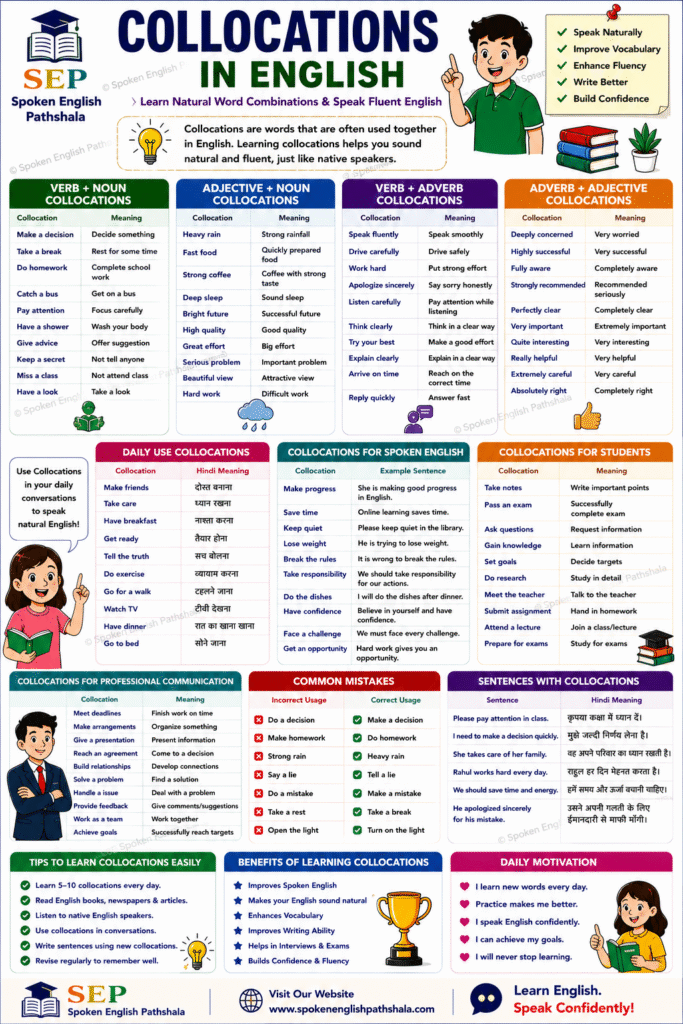
Collocations are widely used in:
- Spoken English
- Daily conversations
- IELTS preparation
- Competitive exams
- Professional communication
- Academic writing
At Spoken English Pathshala, we provide simple English grammar lessons, vocabulary improvement, spoken English practice, and communication skill development for learners of all levels.
What are Collocations?
Collocations are words that are frequently used together in English.
Examples:
- Make a decision
- Take a break
- Heavy rain
- Fast food
- Strong coffee
These combinations sound natural to native English speakers.
Importance of Collocations
Learning collocations helps:
- Improve English fluency
- Make speech natural
- Improve writing quality
- Enhance vocabulary
- Improve communication skills
- Build confidence in speaking English
Common Verb + Noun Collocations
| Collocation | Meaning |
|---|---|
| Make a decision | Decide something |
| Take a break | Rest for some time |
| Do homework | Complete school work |
| Catch a bus | Get on a bus |
| Pay attention | Focus carefully |
Common Adjective + Noun Collocations
| Collocation | Meaning |
|---|---|
| Heavy rain | Strong rainfall |
| Fast food | Quickly prepared food |
| Strong coffee | Coffee with strong taste |
| Deep sleep | Sound sleep |
| Bright future | Successful future |
Common Verb + Adverb Collocations
| Collocation | Meaning |
|---|---|
| Speak fluently | Speak smoothly |
| Drive carefully | Drive safely |
| Work hard | Put strong effort |
| Apologize sincerely | Say sorry honestly |
| Listen carefully | Pay attention while listening |
Common Adverb + Adjective Collocations
| Collocation | Meaning |
|---|---|
| Deeply concerned | Very worried |
| Highly successful | Very successful |
| Fully aware | Completely aware |
| Strongly recommended | Recommended seriously |
| Perfectly clear | Completely clear |
Daily Use Collocations
| Collocation | Hindi Meaning |
|---|---|
| Make friends | दोस्त बनाना |
| Take care | ध्यान रखना |
| Have breakfast | नाश्ता करना |
| Get ready | तैयार होना |
| Tell the truth | सच बोलना |
Collocations for Spoken English
| Collocation | Example Sentence |
|---|---|
| Make progress | She is making good progress in English. |
| Save time | Online learning saves time. |
| Keep quiet | Please keep quiet in the classroom. |
| Lose weight | Rahul wants to lose weight. |
| Break the rules | Students should not break the rules. |
Collocations for Students
| Collocation | Meaning |
|---|---|
| Take notes | Write important points |
| Pass an exam | Successfully complete exam |
| Ask questions | Request information |
| Gain knowledge | Learn information |
| Set goals | Decide targets |
Collocations for Professional Communication
| Collocation | Meaning |
|---|---|
| Meet deadlines | Finish work on time |
| Make arrangements | Organize something |
| Give a presentation | Present information |
| Reach an agreement | Come to a decision |
| Build relationships | Develop connections |
Common Mistakes in Collocations
| Incorrect Usage | Correct Usage |
|---|---|
| Do a decision | Make a decision |
| Make homework | Do homework |
| Strong rain | Heavy rain |
| Say a lie | Tell a lie |
| Do a mistake | Make a mistake |
Daily Use Sentences with Collocations
| English Sentence | Hindi Meaning |
|---|---|
| Please pay attention in class. | कृपया कक्षा में ध्यान दें। |
| I need to make a decision quickly. | मुझे जल्दी निर्णय लेना है। |
| She takes care of her family. | वह अपने परिवार का ध्यान रखती है। |
| Rahul works hard every day. | राहुल हर दिन मेहनत करता है। |
Tips to Learn Collocations Easily
Learn Daily
Practice 5–10 collocations every day.
Read English Content
Reading improves vocabulary and usage.
Listen to Native English
Listening improves fluency and pronunciation.
Use in Conversations
Practice collocations while speaking English.
Practice Writing
Write sentences using collocations.
Revise Frequently
Regular revision improves memory.
Benefits of Learning Collocations
- Improves spoken English
- Makes communication natural
- Enhances vocabulary
- Improves writing ability
- Helps in interviews and exams
- Builds fluency and confidence
Daily Motivation Sentences
| English Sentence | Hindi Meaning |
|---|---|
| I can improve my English fluency daily. | मैं रोज़ अपनी अंग्रेज़ी धाराप्रवाहता सुधार सकता हूँ। |
| Practice improves communication skills. | अभ्यास संवाद कौशल सुधारता है। |
| I will speak English confidently. | मैं आत्मविश्वास से अंग्रेज़ी बोलूँगा। |
| Learning English is useful for success. | सफलता के लिए अंग्रेज़ी सीखना उपयोगी है। |
Collocations are essential for fluent and natural English communication. Daily practice, reading, speaking, and listening help learners understand and use collocations confidently in conversations, interviews, exams, and professional communication.
Remember:
- Learn new collocations daily
- Practice regularly
- Use them in conversations
- Improve vocabulary continuously
- Revise frequently
At Spoken English Pathshala, we provide vocabulary lessons, spoken English practice, grammar guidance, and communication skill development for learners and competitive exam students.
FAQs About Collocations
Q1. What are collocations?
Collocations are words that are commonly used together.
Q2. Why are collocations important?
They make English sound natural and fluent.
Q3. How can I improve collocations?
Practice daily and use them in conversations.
Q4. Are collocations useful for IELTS and competitive exams?
Yes, collocations are important for speaking and writing sections.
Q5. What is the best way to remember collocations?
Use them regularly in speaking and writing.