
Railway Exam English is an important subject for competitive railway exams such as:
- RRB NTPC
- RRB Group D
- RRB JE
- RRB ALP
- RRB Technician
- Other Railway Recruitment Exams
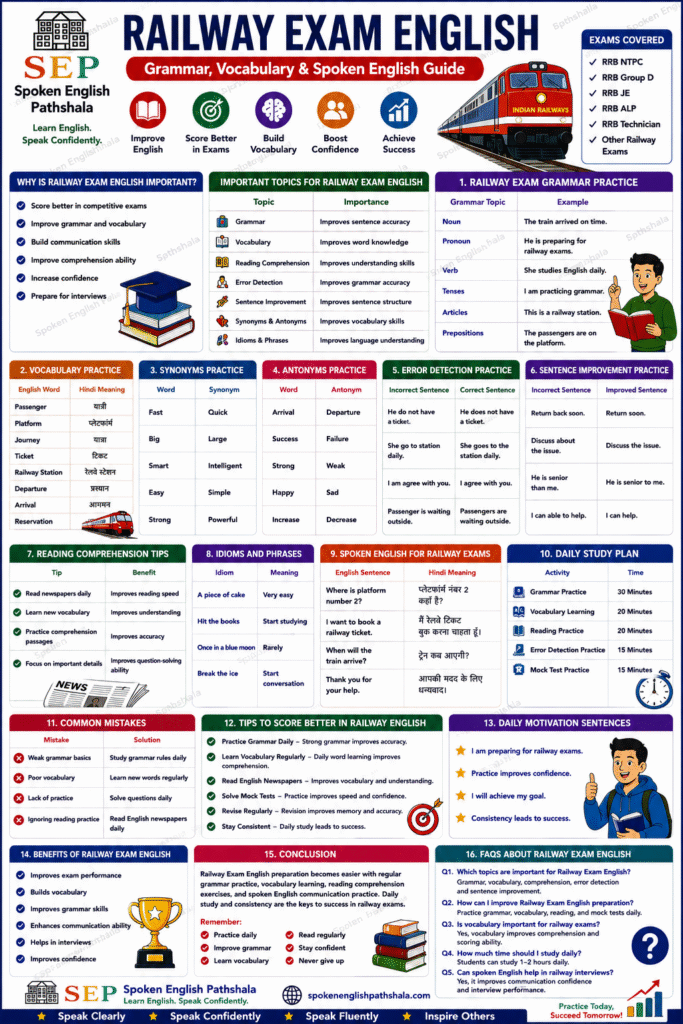
English preparation helps students improve:
- Grammar
- Vocabulary
- Reading comprehension
- Sentence correction
- Error detection
- Spoken English and communication skills
At Spoken English Pathshala, we provide Railway Exam English lessons, grammar guidance, vocabulary practice, spoken English training, and competitive exam preparation support for learners and students.
Why is Railway Exam English Important?
Railway Exam English helps learners:
- Score better in competitive exams
- Improve grammar and vocabulary
- Build communication skills
- Improve comprehension ability
- Increase confidence
- Prepare for interviews and professional communication
Important Topics for Railway Exam English
| Topic | Importance |
|---|---|
| Grammar | Improves sentence accuracy |
| Vocabulary | Improves word knowledge |
| Reading Comprehension | Improves understanding skills |
| Error Detection | Improves grammar accuracy |
| Sentence Improvement | Improves sentence structure |
| Synonyms & Antonyms | Improves vocabulary skills |
| Idioms & Phrases | Improves language understanding |
1. Railway Exam Grammar Practice
| Grammar Topic | Example |
|---|---|
| Noun | The train arrived on time. |
| Pronoun | He is preparing for railway exams. |
| Verb | She studies English daily. |
| Tenses | I am practicing grammar. |
| Articles | This is a railway station. |
| Prepositions | The passengers are on the platform. |
2. Vocabulary Practice
| English Word | Hindi Meaning |
|---|---|
| Passenger | यात्री |
| Platform | प्लेटफॉर्म |
| Journey | यात्रा |
| Ticket | टिकट |
| Railway Station | रेलवे स्टेशन |
| Departure | प्रस्थान |
| Arrival | आगमन |
| Reservation | आरक्षण |
3. Synonyms Practice
| Word | Synonym |
|---|---|
| Fast | Quick |
| Big | Large |
| Smart | Intelligent |
| Easy | Simple |
| Strong | Powerful |
4. Antonyms Practice
| Word | Antonym |
|---|---|
| Arrival | Departure |
| Success | Failure |
| Strong | Weak |
| Happy | Sad |
| Increase | Decrease |
5. Error Detection Practice
| Incorrect Sentence | Correct Sentence |
|---|---|
| He do not have a ticket. | He does not have a ticket. |
| She go to station daily. | She goes to the station daily. |
| I am agree with you. | I agree with you. |
| Passenger is waiting outside. | Passengers are waiting outside. |
6. Sentence Improvement Practice
| Incorrect Sentence | Improved Sentence |
|---|---|
| Return back soon. | Return soon. |
| Discuss about the issue. | Discuss the issue. |
| He is senior than me. | He is senior to me. |
| I can able to help. | I can help. |
7. Reading Comprehension Tips
| Tip | Benefit |
|---|---|
| Read newspapers daily | Improves reading speed |
| Learn new vocabulary | Improves understanding |
| Practice comprehension passages | Improves accuracy |
| Focus on important details | Improves question-solving ability |
8. Idioms and Phrases
| Idiom | Meaning |
|---|---|
| A piece of cake | Very easy |
| Hit the books | Start studying |
| Once in a blue moon | Rarely |
| Break the ice | Start conversation |
9. Spoken English for Railway Exams
| English Sentence | Hindi Meaning |
|---|---|
| Where is platform number 2? | प्लेटफॉर्म नंबर 2 कहाँ है? |
| I want to book a railway ticket. | मैं रेलवे टिकट बुक करना चाहता हूँ। |
| When will the train arrive? | ट्रेन कब आएगी? |
| Thank you for your help. | आपकी मदद के लिए धन्यवाद। |
10. Daily Railway Exam English Study Plan
| Activity | Time |
|---|---|
| Grammar Practice | 30 Minutes |
| Vocabulary Learning | 20 Minutes |
| Reading Practice | 20 Minutes |
| Error Detection Practice | 15 Minutes |
| Mock Test Practice | 15 Minutes |
Common Mistakes in Railway Exam English
| Mistake | Solution |
|---|---|
| Weak grammar basics | Study grammar rules daily |
| Poor vocabulary | Learn new words regularly |
| Lack of practice | Solve questions daily |
| Ignoring reading practice | Read English newspapers daily |
Tips to Score Better in Railway Exam English
Practice Grammar Daily
Strong grammar improves accuracy.
Learn Vocabulary Regularly
Daily vocabulary learning improves comprehension.
Read English Newspapers
Reading improves vocabulary and comprehension.
Solve Mock Tests
Practice improves speed and confidence.
Revise Regularly
Revision improves memory and accuracy.
Stay Consistent
Daily study leads to success.
Daily Motivation Sentences
| English Sentence | Hindi Meaning |
|---|---|
| I am preparing for railway exams. | मैं रेलवे परीक्षा की तैयारी कर रहा हूँ। |
| Practice improves confidence. | अभ्यास आत्मविश्वास बढ़ाता है। |
| I will achieve my goal. | मैं अपना लक्ष्य प्राप्त करूँगा। |
| Consistency leads to success. | निरंतरता सफलता की ओर ले जाती है। |
Benefits of Railway Exam English Preparation
- Improves exam performance
- Builds vocabulary
- Improves grammar skills
- Enhances communication ability
- Helps in interviews
- Improves confidence
Railway Exam English preparation becomes easier with regular grammar practice, vocabulary learning, reading comprehension exercises, and spoken English communication practice. Daily study and consistency are the keys to success in railway competitive exams.
Remember:
- Practice daily
- Improve grammar
- Learn vocabulary
- Read regularly
- Stay confident
At Spoken English Pathshala, we provide practical English lessons, grammar guidance, vocabulary practice, and spoken English training for railway and competitive exam students.
FAQs About Railway Exam English
Q1. Which topics are important for Railway Exam English?
Grammar, vocabulary, comprehension, error detection, and sentence improvement.
Q2. How can I improve Railway Exam English preparation?
Practice grammar, vocabulary, reading, and mock tests daily.
Q3. Is vocabulary important for railway exams?
Yes, vocabulary improves comprehension and scoring ability.
Q4. How much time should I study Railway Exam English daily?
Students can study 1–2 hours daily.
Q5. Can spoken English help in railway interviews?
Yes, spoken English improves communication confidence and interview performance.