
Sentence structure is one of the most important parts of English grammar. It helps learners arrange words correctly to create meaningful and grammatically correct sentences.
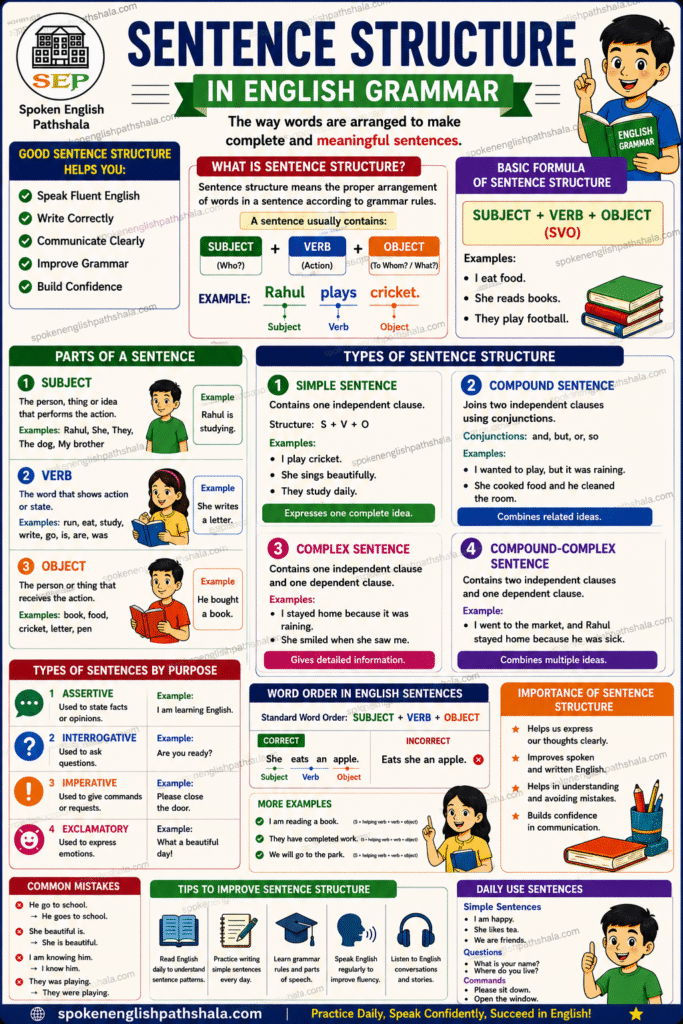
A good sentence structure improves:
- Spoken English
- Writing Skills
- Communication
- Grammar Accuracy
- Confidence in English Speaking
At Spoken English Pathshala, we simplify grammar concepts to help beginners learn English easily and confidently.
What is Sentence Structure?
Sentence structure refers to the arrangement of words in a sentence according to grammar rules.
A sentence usually contains:
- Subject
- Verb
- Object
Example:
Rahul plays cricket.
- Rahul → Subject
- Plays → Verb
- Cricket → Object
A correct sentence structure helps people understand the meaning clearly.
Basic Formula of Sentence Structure
Subject + Verb + Object (SVO)
This is the most common English sentence pattern.
Examples:
- I eat food.
- She reads books.
- They play football.
Parts of a Sentence
1. Subject
The subject is the person, thing, or idea performing the action.
Examples:
- Rahul
- She
- They
- The dog
Sentence:
Rahul is studying.
2. Verb
The verb shows action or state.
Examples:
- Run
- Eat
- Study
- Write
Sentence:
She writes a letter.
3. Object
The object receives the action.
Examples:
- Book
- Food
- Cricket
- Letter
Sentence:
He bought a book.
Types of Sentence Structure
There are four main types of sentence structure in English grammar.
1. Simple Sentence
A simple sentence contains one independent clause.
Structure:
Subject + Verb + Object
Examples:
- I play cricket.
- She sings beautifully.
- They study daily.
Features:
- Easy to understand
- Expresses one idea
2. Compound Sentence
A compound sentence joins two independent clauses using conjunctions.
Common Conjunctions:
- And
- But
- Or
- So
Examples:
- I wanted to play, but it was raining.
- She cooked food and he cleaned the room.
Features:
- Combines related ideas
- Improves sentence variety
3. Complex Sentence
A complex sentence contains one independent clause and one dependent clause.
Examples:
- I stayed home because it was raining.
- She smiled when she saw me.
Features:
- Gives detailed information
- Uses words like because, although, when, if
4. Compound-Complex Sentence
A compound-complex sentence contains two independent clauses and one dependent clause.
Example:
- I went to the market, and Rahul stayed home because he was sick.
Features:
- Advanced sentence structure
- Combines multiple ideas
Types of Sentences by Purpose
1. Assertive Sentence
Used to state facts or opinions.
Example:
I am learning English.
2. Interrogative Sentence
Used to ask questions.
Example:
Are you ready?
3. Imperative Sentence
Used to give commands or requests.
Example:
Please close the door.
4. Exclamatory Sentence
Used to express emotions.
Example:
What a beautiful day!
Word Order in English Sentences
Correct word order is very important in English.
Standard English Word Order:
Subject + Verb + Object
Correct:
She eats an apple.
Incorrect:
Eats she an apple.
Examples of Sentence Structure
| Sentence | Structure |
|---|---|
| Rahul plays cricket. | Subject + Verb + Object |
| She is reading a book. | Subject + Helping Verb + Verb + Object |
| They have completed work. | Subject + Helping Verb + Verb + Object |
Importance of Sentence Structure
Good sentence structure helps learners:
- Speak clearly
- Write correctly
- Improve grammar
- Build confidence
- Communicate effectively
Common Sentence Structure Mistakes
Incorrect:
He go to school.
Correct:
He goes to school.
Incorrect:
She beautiful is.
Correct:
She is beautiful.
Tips to Improve Sentence Structure
Read English Daily
Reading improves understanding of sentence formation.
Practice Writing
Write simple sentences every day.
Learn Grammar Rules
Understand tenses and parts of speech.
Speak English Regularly
Daily speaking practice improves fluency.
Listen to English Conversations
Listening helps learners understand natural sentence patterns.
Sentence Structure in Spoken English
Sentence structure is very important in spoken English because it helps:
- Express ideas clearly
- Avoid grammar mistakes
- Improve fluency
- Increase confidence
Simple and correct sentences make communication easier.
Daily Use Sentence Examples
Simple Sentences
- I am happy.
- She likes tea.
- We are friends.
Questions
- What is your name?
- Where do you live?
Commands
- Please sit down.
- Open the window.
Sentence structure is the foundation of English communication. Learning how to arrange words correctly helps learners improve grammar, speaking, writing, and confidence.
With regular practice, anyone can create clear and meaningful English sentences.
At Spoken English Pathshala, we provide easy grammar lessons and spoken English practice for learners of all levels.
FAQs About Sentence Structure
Q1. What is sentence structure?
Sentence structure is the arrangement of words in a sentence according to grammar rules.
Q2. What is the basic English sentence structure?
The basic structure is:
Subject + Verb + Object
Q3. Why is sentence structure important?
It helps learners create correct and meaningful sentences.
Q4. How can beginners improve sentence structure?
Beginners can improve through reading, writing, grammar practice, and speaking exercises.
Q5. Does sentence structure improve spoken English?
Yes, proper sentence structure improves communication and speaking confidence.