
Tenses are one of the most important topics in English grammar. They help us understand the time of an action — whether the action happens now, happened in the past, or will happen in the future.
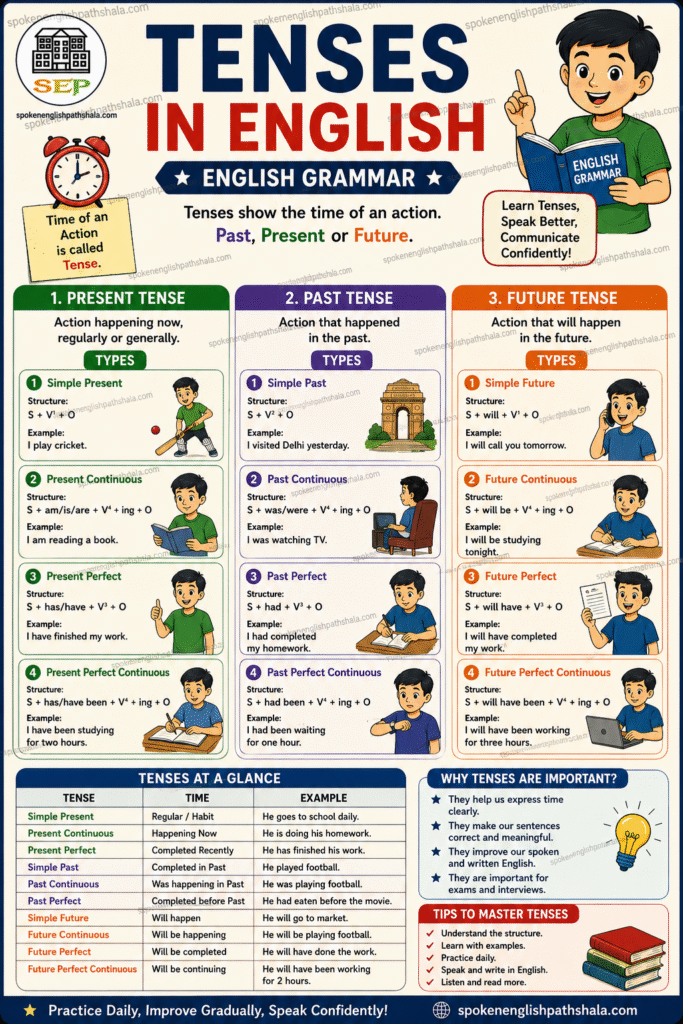
Learning English tenses is essential for:
- Spoken English
- Writing Skills
- Sentence Formation
- Communication
- Competitive Exams
At Spoken English Pathshala, we explain English grammar in a simple and beginner-friendly way to help learners improve their speaking and writing skills.
What are Tenses?
Tenses show the time of an action or event in a sentence.
Example:
- I play cricket. → Present
- I played cricket. → Past
- I will play cricket. → Future
Tenses help make communication clear and meaningful.
Types of Tenses in English
There are 3 main types of tenses:
- Present Tense
- Past Tense
- Future Tense
Each tense has 4 sub-types:
- Simple
- Continuous
- Perfect
- Perfect Continuous
Total = 12 Tenses
1. Present Tense
Present tense describes actions happening now, regularly, or generally.
Types of Present Tense
A. Simple Present Tense
Used for daily routines, habits, and facts.
Structure:
Subject + Verb (1st form) + Object
Examples:
- She goes to school daily.
- I play football.
- The sun rises in the east.
B. Present Continuous Tense
Used for actions happening right now.
Structure:
Subject + is/am/are + Verb + ing
Examples:
- She is reading a book.
- They are playing cricket.
- I am learning English.
C. Present Perfect Tense
Used for actions completed recently.
Structure:
Subject + has/have + Verb (3rd form)
Examples:
- I have finished my homework.
- She has gone to the market.
- They have completed the project.
D. Present Perfect Continuous Tense
Used for actions continuing for a period of time.
Structure:
Subject + has/have been + Verb + ing
Examples:
- I have been studying for two hours.
- She has been working since morning.
- They have been playing since 5 PM.
2. Past Tense
Past tense describes actions that happened in the past.
Types of Past Tense
A. Simple Past Tense
Used for completed past actions.
Structure:
Subject + Verb (2nd form)
Examples:
- I visited Delhi yesterday.
- She watched a movie.
- They played cricket.
B. Past Continuous Tense
Used for actions happening at a particular time in the past.
Structure:
Subject + was/were + Verb + ing
Examples:
- She was cooking food.
- They were playing football.
- I was reading a newspaper.
C. Past Perfect Tense
Used for actions completed before another past action.
Structure:
Subject + had + Verb (3rd form)
Examples:
- I had completed my work.
- She had left before I arrived.
- They had finished the match.
D. Past Perfect Continuous Tense
Used for actions continuing for some time before another action in the past.
Structure:
Subject + had been + Verb + ing
Examples:
- I had been studying for two hours.
- She had been waiting since morning.
- They had been playing before rain started.
3. Future Tense
Future tense describes actions that will happen later.
Types of Future Tense
A. Simple Future Tense
Used for future actions.
Structure:
Subject + will + Verb (1st form)
Examples:
- I will call you tomorrow.
- She will visit Jaipur.
- They will play cricket.
B. Future Continuous Tense
Used for actions that will be happening in the future.
Structure:
Subject + will be + Verb + ing
Examples:
- I will be studying tonight.
- She will be working tomorrow.
- They will be traveling next week.
C. Future Perfect Tense
Used for actions completed before a future time.
Structure:
Subject + will have + Verb (3rd form)
Examples:
- I will have completed my work.
- She will have arrived by evening.
- They will have finished the project.
D. Future Perfect Continuous Tense
Used for actions continuing until a future point.
Structure:
Subject + will have been + Verb + ing
Examples:
- I will have been studying for three hours.
- She will have been working all day.
- They will have been traveling since morning.
Importance of Learning Tenses
Tenses help learners:
- Speak English correctly
- Understand time in sentences
- Improve communication skills
- Write proper English
- Build confidence in spoken English
Easy Tense Chart
| Tense | Example |
|---|---|
| Simple Present | I eat food. |
| Present Continuous | I am eating food. |
| Present Perfect | I have eaten food. |
| Simple Past | I ate food. |
| Past Continuous | I was eating food. |
| Simple Future | I will eat food. |
Common Mistakes in Tenses
Incorrect:
He go to school.
Correct:
He goes to school.
Incorrect:
I am knowing him.
Correct:
I know him.
Tips to Learn Tenses Easily
Practice Daily
Make English sentences using different tenses.
Read English Books
Reading improves grammar understanding.
Watch English Videos
Listening helps learners understand tense usage naturally.
Speak English Regularly
Daily speaking practice improves fluency.
Learn Structures
Memorize tense structures and examples.
Tenses in Spoken English
Tenses are very important in spoken communication because they help explain:
- Time
- Actions
- Events
- Habits
- Future plans
Correct tense usage makes English more professional and understandable.
Tenses are the backbone of English grammar. Understanding present, past, and future tenses helps learners speak and write English correctly and confidently.
With regular practice, anyone can master English tenses and improve spoken English fluency.
At Spoken English Pathshala, we provide simple grammar lessons and speaking practice for learners of all levels.
FAQs About English Tenses
Q1. What are tenses in English grammar?
Tenses show the time of an action or event.
Q2. How many tenses are there in English?
There are 12 main tenses in English grammar.
Q3. Why are tenses important?
Tenses help learners speak and write English correctly.
Q4. Which tense is most used in spoken English?
Simple Present, Present Continuous, and Simple Past are commonly used in daily conversation.
Q5. How can beginners learn tenses easily?
Beginners can learn tenses through regular practice, sentence formation, reading, and speaking exercises.